Our answer
6 Feb 2027 农历
Year of the Goat; no leap month
The short answer
In the Chinese calendar, 2027 is the Year of the Goat, starting on Saturday 6 February. China’s official schedule gives a nine-day Spring Festival break (5–13 February) and a seven-day National Day holiday (1–7 October). Other key dates: Lantern Festival 20 February, Qingming 5 April, Dragon Boat 9 June, Mid-Autumn 15 September.
| Lunar year | Year of the Goat, 6 February 2027 to 25 January 2028 |
|---|---|
| Chinese New Year | Saturday 6 February 2027 (New Year’s Eve: Friday 5 February) |
| Public holidays | 7 holidays, 29 days off, 5 weekend make-up workdays |
| Longest breaks | Spring Festival 5–13 February (9 days), National Day 1–7 October (7 days) |
| Leap month | None in 2027 |
| In Chinese | 农历 (nónglì, the traditional calendar), 节假日 (jiéjiàrì, public holidays) |
China public holidays 2027: the official schedule
Published by the General Office of the State Council on 5 November 2026. Make-up workdays are weekend days when offices and schools open as normal, to pay for the longer breaks.[1][2]
| Holiday | Days off | Length | Make-up workdays |
|---|---|---|---|
| New Year’s Day (元旦) | Fri 1 – Sun 3 January | 3 days | None |
| Spring Festival (春节) | Fri 5 – Sat 13 February | 9 days | Sun 31 January, Sun 14 February |
| Qingming Festival (清明节) | Sat 3 – Mon 5 April | 3 days | None |
| Labour Day (劳动节) | Sat 1 – Wed 5 May | 5 days | Sat 8 May |
| Dragon Boat Festival (端午节) | Wed 9 June | 1 day | None |
| Mid-Autumn Festival (中秋节) | Wed 15 September | 1 day | None |
| National Day (国庆节) | Fri 1 – Thu 7 October | 7 days | Sun 26 September, Sat 9 October |
How China’s holiday schedule works
By law, mainland China has 13 public holiday days a year for everyone: one for New Year’s Day, four for Spring Festival (New Year’s Eve and the first three days of the lunar year), one each for Qingming, Dragon Boat and Mid-Autumn, two for Labour Day and three for National Day. The current rules took effect on 1 January 2025.
Each autumn the State Council turns those days into the next year’s schedule, swapping weekend days to build longer breaks. The law says that, except in special cases, people should not have to work more than six days in a row before or after a holiday. In 2027 the swaps produce a nine-day Spring Festival and a seven-day Golden Week in October, while the Dragon Boat and Mid-Autumn festivals fall on Wednesdays and get a single day off each.
Some days off are for particular groups only: women get half a day on International Women’s Day (Monday 8 March 2027), young people aged 14 and over half a day on Youth Day (Tuesday 4 May) and children under 14 a day on Children’s Day (Tuesday 1 June). These are not made up when they fall on a weekend.
For a day-by-day view, use our China holiday planner.[1][3]
Chinese festivals 2027: dates
Most traditional festivals follow the lunar calendar, so their Western dates change every year. Qingming and the Winter Solstice are solar terms and follow the sun.[4]
| Date | Festival | Lunar date |
|---|---|---|
| Fri 15 January | Laba Festival (腊八节) | 12th month, day 8 (Year of the Horse) |
| Fri 5 February | Chinese New Year’s Eve (除夕) | 12th month, day 29 |
| Sat 6 February | Chinese New Year (春节) | 1st month, day 1 |
| Sat 20 February | Lantern Festival (元宵节) | 1st month, day 15 |
| Mon 5 April | Qingming Festival (清明节) | Solar term |
| Wed 9 June | Dragon Boat Festival (端午节) | 5th month, day 5 |
| Sun 8 August | Qixi Festival (七夕) | 7th month, day 7 |
| Mon 16 August | Zhongyuan Festival (中元节) | 7th month, day 15 |
| Wed 15 September | Mid-Autumn Festival (中秋节) | 8th month, day 15 |
| Fri 8 October | Double Ninth Festival (重阳节) | 9th month, day 9 |
| Wed 22 December | Winter Solstice (冬至) | Solar term |
The 12th month of the Horse year has 29 days, so New Year’s Eve 2027 falls on the 29th, not the 30th.
What happens at each festival
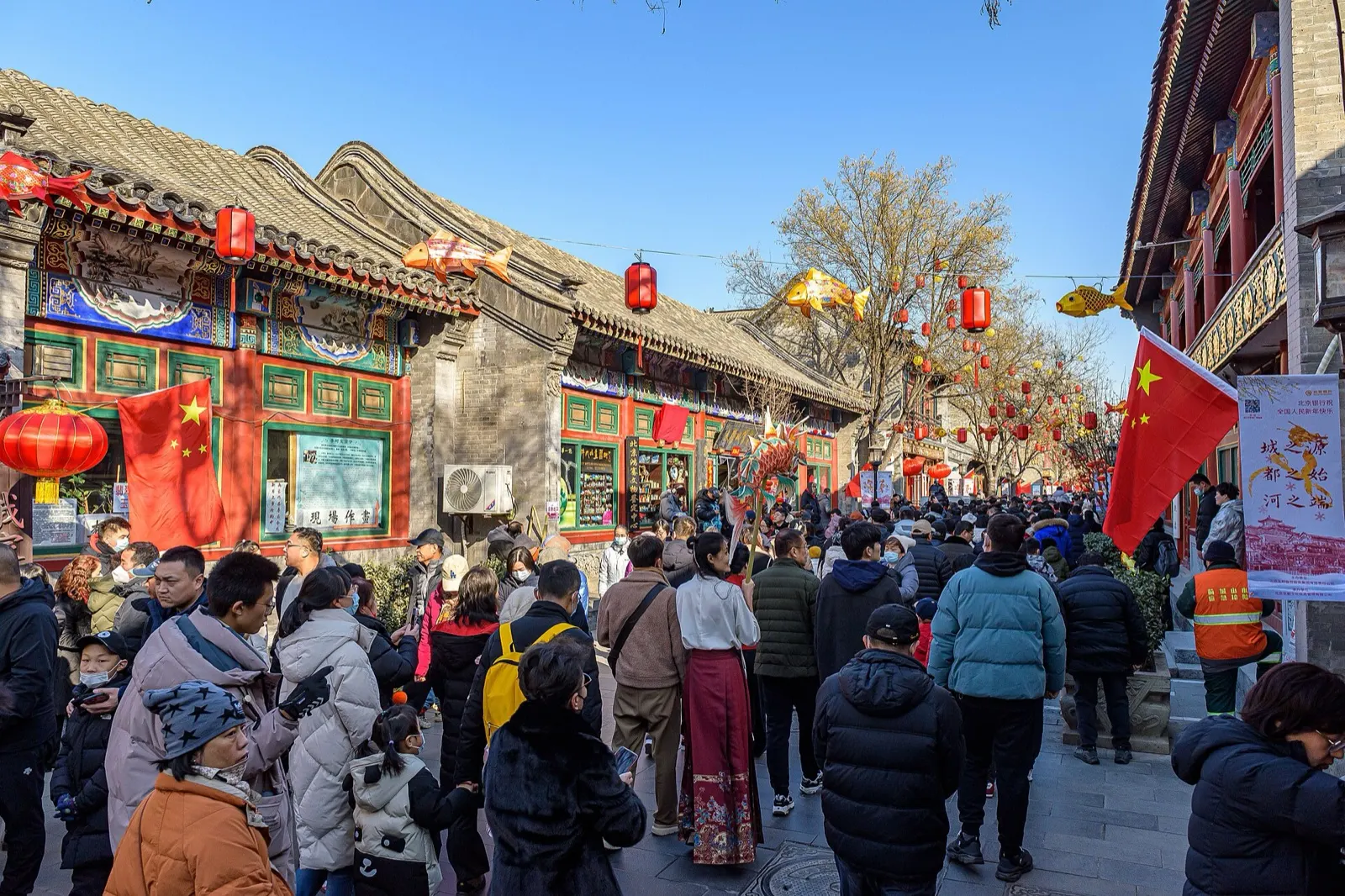

Laba Festival (15 January). Families eat Laba congee, made with grains, beans and dried fruit in styles that change by region; in northern China people pickle garlic in vinegar, which turns green in time for New Year’s Eve dumplings. A saying holds that once Laba has passed, Spring Festival is around the corner.
Chinese New Year and the Lantern Festival (5–20 February). The reunion dinner on New Year’s Eve, red envelopes and temple fairs, ending with lanterns and sweet rice balls on the fifteenth day. Our Chinese New Year 2027 guide covers the season in detail.
Qingming (5 April). A day to honour ancestors: many families visit and tidy graves, then take a walk in the countryside. In Shanghai people eat qingtuan, green glutinous-rice balls coloured with mugwort or barley-grass juice.
Dragon Boat Festival (9 June). Its food is zongzi, sticky rice wrapped in leaves, linked to the poet Qu Yuan of the ancient state of Chu: after he drowned in the Miluo River, people threw bamboo tubes filled with rice into the river as offerings.
Qixi (8 August). The legend of the weaver girl and the cowherd, separated by the Milky Way and allowed to meet once a year on a bridge of magpies. It began as a day for girls to show their needlework; today couples mark it with gifts and flowers, and it is often called Chinese Valentine’s Day.
Mid-Autumn Festival (15 September). Families get together, eat mooncakes and look at the full moon, a custom tied to the legend of Chang’e, who flew to the moon.
Double Ninth Festival (8 October). Also celebrated as a day for honouring older people. Customs include climbing to high ground, admiring chrysanthemums, eating Chongyang cake and, for many families, tending ancestors’ graves.
Winter Solstice (22 December). Seen as being almost as important as New Year, with family reunions and dumplings or tangyuan.[5][6][7][8][9][10][11]
Lunar calendar 2027: when each month starts
Each lunar month has 29 or 30 days. There is no leap month in 2027.[4]
| Lunar month | Starts | Days |
|---|---|---|
| 12th month (腊月) (Year of the Horse) | Fri 8 January 2027 | 29 |
| 1st month (正月) | Sat 6 February 2027 | 30 |
| 2nd month (二月) | Mon 8 March 2027 | 30 |
| 3rd month (三月) | Wed 7 April 2027 | 29 |
| 4th month (四月) | Thu 6 May 2027 | 30 |
| 5th month (五月) | Sat 5 June 2027 | 29 |
| 6th month (六月) | Sun 4 July 2027 | 29 |
| 7th month (七月) | Mon 2 August 2027 | 30 |
| 8th month (八月) | Wed 1 September 2027 | 29 |
| 9th month (九月) | Thu 30 September 2027 | 29 |
| 10th month (十月) | Fri 29 October 2027 | 30 |
| 11th month (冬月) | Sun 28 November 2027 | 30 |
| 12th month (腊月) (Year of the Goat; ends 25 January 2028) | Tue 28 December 2027 | 29 |
The 24 solar terms in 2027
The solar terms divide the sun’s yearly path into 24 segments, from the Start of Spring to Major Cold. They remain especially important to farmers.[4][12]
| Date | Solar term |
|---|---|
| Tue 5 January | Minor Cold (小寒) |
| Wed 20 January | Major Cold (大寒) |
| Thu 4 February | Start of Spring (立春) |
| Fri 19 February | Rain Water (雨水) |
| Sat 6 March | Awakening of Insects (惊蛰) |
| Sun 21 March | Spring Equinox (春分) |
| Mon 5 April | Pure Brightness (Qingming) (清明) |
| Tue 20 April | Grain Rain (谷雨) |
| Thu 6 May | Start of Summer (立夏) |
| Fri 21 May | Grain Buds (小满) |
| Sun 6 June | Grain in Ear (芒种) |
| Mon 21 June | Summer Solstice (夏至) |
| Wed 7 July | Minor Heat (小暑) |
| Fri 23 July | Major Heat (大暑) |
| Sun 8 August | Start of Autumn (立秋) |
| Mon 23 August | End of Heat (处暑) |
| Wed 8 September | White Dew (白露) |
| Thu 23 September | Autumn Equinox (秋分) |
| Fri 8 October | Cold Dew (寒露) |
| Sat 23 October | Frost's Descent (霜降) |
| Sun 7 November | Start of Winter (立冬) |
| Mon 22 November | Minor Snow (小雪) |
| Tue 7 December | Major Snow (大雪) |
| Wed 22 December | Winter Solstice (冬至) |
How the Chinese calendar works
The traditional Chinese calendar (农历) is lunisolar: its months follow the moon, while the 24 solar terms track the sun. The terms began in the Yellow River region, where they were worked out by observing the seasons and the sky, and UNESCO added them to its list of the intangible cultural heritage of humanity in 2016.
The lunar calendar sets the traditional festivals and the zodiac year. To convert any date, birthday or festival, use our Chinese calendar converter.[12][4]
Questions readers ask
What year is 2027 in the Chinese calendar?
The Year of the Goat (羊, also translated Sheep). It starts on Saturday 6 February 2027 and ends on 25 January 2028.
Is there a leap month in the 2027 lunar calendar?
No. The 2027 lunar year has twelve months, from 6 February 2027 to 25 January 2028.
When is Golden Week 2027?
National Day Golden Week runs from Friday 1 October to Thursday 7 October 2027. Sunday 26 September and Saturday 9 October are working days.
How long is the 2027 Spring Festival holiday?
Nine days, from Friday 5 February (New Year’s Eve) to Saturday 13 February. Sunday 31 January and Sunday 14 February are working days.
When is the Mid-Autumn Festival in 2027?
Wednesday 15 September 2027. It is a single day off in mainland China.
When is the Dragon Boat Festival in 2027?
Wednesday 9 June 2027, a single day off in mainland China.
Sources
- Xinhua, State Council General Office notice on the 2027 public holiday schedule (5 November 2026, in Chinese) · accessed 10 Nov 2026
- National Forestry and Grassland Administration, State Council notice on the 2027 public holiday schedule (5 November 2026, in Chinese) · accessed 10 Nov 2026
- Xinhua, State Council decision amending the national public holiday rules (12 November 2024, in Chinese) · accessed 10 Nov 2026
- Hong Kong Observatory, Gregorian-Lunar calendar 2027 · accessed 10 Nov 2026
- Shanghai government, Laba Festival (21 January 2026) · accessed 10 Nov 2026
- Shanghai government, Spring outing for Qingming (3 April 2026) · accessed 10 Nov 2026
- Shanghai government, Tradition with a twist: Shanghai’s zongzi guide (18 June 2026) · accessed 10 Nov 2026
- Shanghai government, The story behind Qixi Festival (6 August 2024) · accessed 10 Nov 2026
- Shanghai government, Festive China: Mid-Autumn Festival (17 September 2024) · accessed 10 Nov 2026
- Shanghai government, Share blessings and good fortune on Chongyang Festival (29 October 2025) · accessed 10 Nov 2026
- Beijing government, Discover Winter Solstice in Beijing (23 December 2024) · accessed 10 Nov 2026
- UNESCO, The Twenty-Four Solar Terms (inscribed 2016) · accessed 10 Nov 2026
Update log. 10 November 2026 — reviewed. Next review due 10 January 2027. Suggest a correction