Our answer
Rain spirit, not fire monster 龙
A good-luck and water symbol; the fire-breathing dragon is the Western one
The short answer
The Chinese dragon (龙, lóng) is a legendary creature of Chinese mythology, usually drawn snake-like with four legs. It controls water and weather and stands for good luck, prosperity and imperial power. Unlike the fire-breathing Western dragon, it is a benevolent symbol of rain and harmony.
| Name | 龙 lóng, also spelled long or loong; over 100 dragon names appear in classical texts |
|---|---|
| Usual form | Snake-like with four legs; turtle and fish forms also occur |
| Power | Rain, rivers, seas and weather; a rain deity that fosters harmony |
| Claws | Five claws marked the imperial family (Met robe records) |
| Colours | Yellow for the royal family; five directional dragons (azure, red, white, black, yellow) |
| Numbers | Nine resemblances, nine sons, 117 scales (81 yang, 36 yin) |
| Today | Dragon dance at New Year, dragon boat races, Dragon King temples, Dragon-year births |
What the Chinese dragon is
The Chinese dragon, lóng (龙), also spelled long or loong, is a legendary creature of Chinese mythology and folklore. It is most often shown snake-like with four legs, though turtle and fish forms exist. Its power is over water. In popular religion it rules rivers, waterfalls and seas, and it is the giver of rain.
Scholars have proposed four origins: snakes, Chinese alligators, thunder worship and nature worship. Coiled, dragon-like jade pieces have been dug up at Hongshan culture sites (c. 4700–2900 BC), and the character for dragon in the earliest writing has a similar coiled shape.
The contrast with the West matters. In European culture the dragon breathes fire and is seen as aggressive. The Chinese dragon is a symbol of prosperity and good luck, and a rain deity.[1]
The nine resemblances
The Han scholar Wang Fu recorded the myth that a long dragon has nine animal resemblances. The list below is the classical one.[1]
| Part | Like a… |
|---|---|
| Antlers | stag |
| Head | camel |
| Eyes | demon |
| Neck | snake |
| Belly | clam (shen 蜃) |
| Scales | carp |
| Claws | eagle |
| Soles | tiger |
| Ears | cow |
Other lists differ. The sinologist Henri Doré gives a crocodile’s head, a tortoise’s viscera, a hawk’s claws and a tiger’s palms; others give a rabbit’s eyes and a frog’s belly. The same tradition says a dragon needs a lump on its head, the chimu (尺木), to rise into the sky.
Claws and colours: what they meant
Claws and colours marked rank and direction. Five claws and yellow belonged to the imperial family; each of the five directions had a dragon of its own colour.[4][15][18][19]
| Mark or colour | What it meant | Where you see it |
|---|---|---|
| Five claws | A mark of the imperial family. The Met’s curator reads five claws on a Qing robe as showing the wearer was an imperial-family member | Qing robes in the Met, New York; imperial palaces in Beijing |
| Yellow | The colour of the royal family; roofs and decoration in the Forbidden City are yellow | Forbidden City, Beijing |
| Azure (blue-green) dragon | Dragon God of the east and of spring; one of the Four Symbols | East; element wood |
| Red dragon | Dragon God of the south and of summer | South |
| White dragon | Dragon God of the west and of autumn | West |
| Black dragon | Dragon God of the north and of winter | North |
| Yellow dragon | Dragon God of the centre, linked with the Yellow Emperor | Centre; late summer |
The nine sons of the dragon (龙生九子)
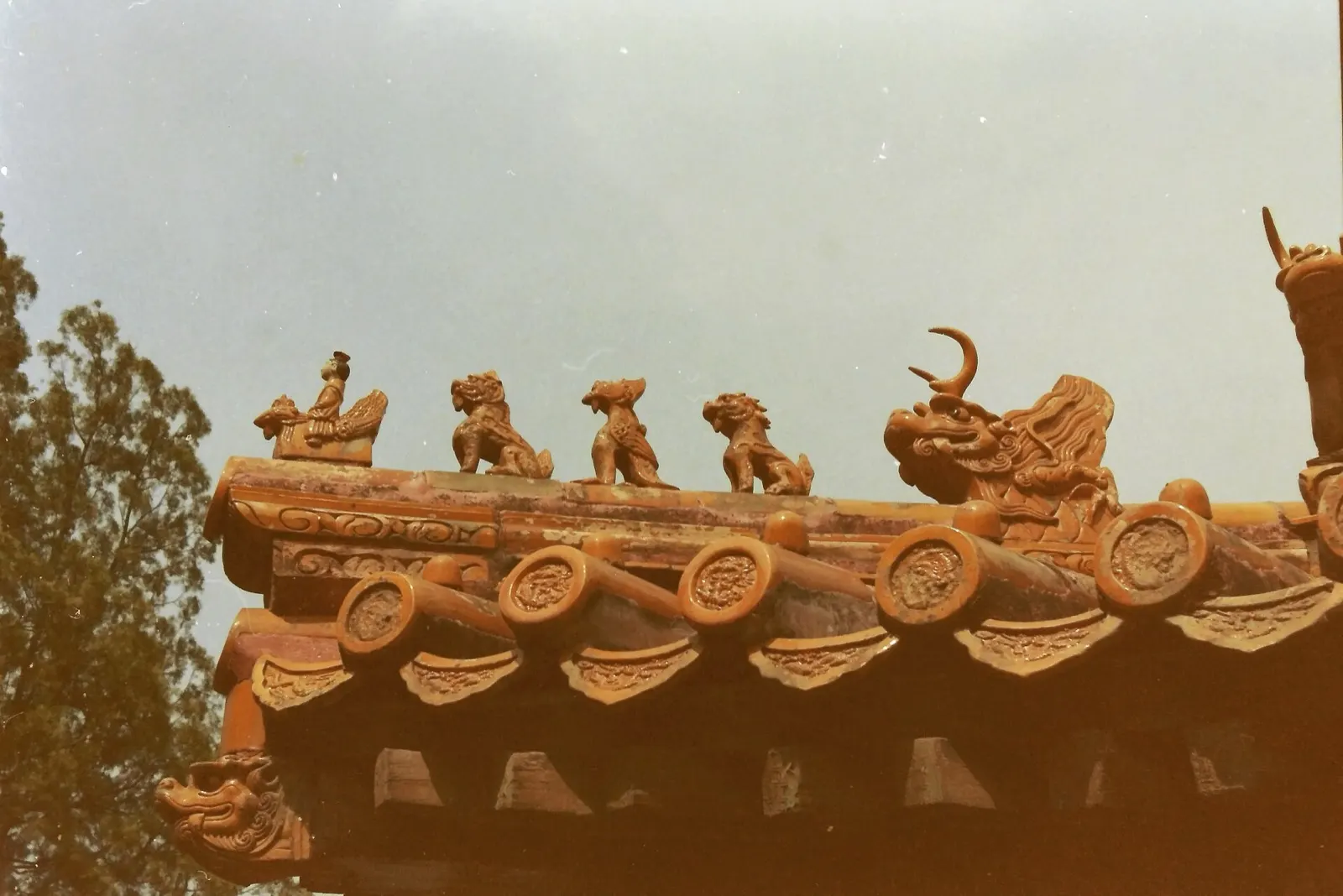

Lists differ by source. Four principal versions exist: Lu Rong (1436–1494) listed 14 creatures, Li Dongyang (1447–1516) and Fang Yizhi (1611–1671) gave others, and Yang Shen (1488–1559) gave the version most widely found, shown here. These are decorative creatures on buildings and objects, not gods.[2]
| Son | Where it sits | What it likes |
|---|---|---|
| Bixi (贔屭) | Under stone steles, as a turtle-like base | Heavy weights |
| Chiwen (螭吻), or Chaofeng (嘲風) in other lists | Roof corners | Gazing |
| Pulao (蒲牢) | Bell tops | Roaring |
| Bi’an (狴犴) | Prison gates | Confronting |
| Taotie (饕餮) | Bronze vessels | Food |
| Qiuniu (囚牛) | Lutes (string instruments) | Music |
| Yazi (睚眦) | Sword handles | Killing |
| Suanni (狻猊) | Incense burners | Smoke |
| Jiaotu (椒圖) | Door knockers | Shutting its mouth |
In 2012, the Shanghai Mint issued a Year of the Dragon coin set with one coin for each son, plus a father-dragon coin.
Dragon Kings: rain and the seas
Dragon Kings are the water and weather gods of popular religion and Daoism. Their cult is one of the most visible dragon traditions outside the palace.
- Four seas. Ao Guang rules the East Sea, Ao Qin the South Sea, Ao Run the West Sea and Ao Shun the North Sea.
- Local temples. Villages near rivers and the sea had temples to their own Dragon King. In drought or flood, officials and gentry led sacrifices to ask for rain, or for it to stop.
- Birthday processions. Processions were held in the fifth and sixth lunar months, especially on the 13th day of the sixth month, said to be the Dragon King’s birthday.
- Under the Jade Emperor. In Daoist belief the Dragon King takes his orders from the Jade Emperor. The title came into China from India through Buddhism, from the naga-raja.
For names with a dragon in them, try the Chinese dragon name generator.
The Azure Dragon and the Four Symbols
The Four Symbols are mythological guardians of the four directions: the Azure Dragon of the east, the Vermilion Bird of the south, the White Tiger of the west and the Black Turtle-Snake of the north. Some lists add a Yellow Dragon at the centre, making five.
Each symbol is tied to a colour, a season and one of the five elements; the Azure Dragon is Wood. Taoist texts give the four guardians human names, and the Azure Dragon is called Meng Zhang (孟章). For the religion behind these figures, see Taoism in China.[3]
Chinese gods and goddesses people still know
These are the sky, household and water figures that still get attention at New Year and in temples.[4][8][10][12][22][23][25][26]
| Name | Chinese | Who they are | When you meet them |
|---|---|---|---|
| Jade Emperor | 玉皇 (Yùhuáng) | Head of the heavenly court in Taoism and folk religion. In one folk tale, the four sea dragons who brought rain became the Yellow, Yangtze, Amur and Pearl rivers | Temple rituals on his birthday, the ninth day of the first lunar month |
| Caishen | 财神 (Cáishén) | The God of Wealth, worshipped in folk religion and Taoism; often shown riding a black tiger | Families welcome him on the fifth day of the first lunar month (Po Wu), when shops reopen |
| Kitchen God | 灶神 (Zàoshén) | The Stove God, the chief household god. Families keep his paper picture above the stove; he watches the household and reports on it to the Jade Emperor once a year | On the 23rd or 24th day of the twelfth lunar month, ‘Little New Year’, families send him off to heaven, sometimes with honey on his lips to sweeten the report; a new picture goes up at New Year |
| Dragon Kings | 四海龙王 (Sìhǎi Lóngwáng) | Rulers of rain and the seas, with temples in river and coastal villages | Rain processions on the 13th day of the sixth lunar month |
| Guanyin | 观音 (Guānyīn) | Bodhisattva Guanyin, also known as Avalokiteśvara; see our Guanyin guide | Buddhist temples across China |
| Chang’e | 嫦娥 (Cháng’é) | Goddess of the Moon, who flew to the Moon with her pet, the Moon rabbit Yu Tu | Mid-Autumn Festival; her story is given as the festival’s origin |
Creation myths and the dragon
Pangu is the giant of the creation myth. A Taoist author writing around 200 CE describes him as the first sentient being and creator, “making the heavens and the earth”.
Nüwa, a mother goddess and culture hero, mended the broken sky with five-coloured stones and used a giant tortoise’s legs as pillars. In the same account she killed the black dragon to bring relief to Ji Province. She is also credited with making humans from yellow clay.[8][11]
Phoenix, qilin and the dragon’s partners
The Chinese phoenix, fenghuang (凤凰), reigns over all other birds. It is generally treated as feminine and paired with the masculine dragon, a visual metaphor for a happy marriage and the balance of yin and yang. The dragon-and-phoenix pair appears in wedding and royal decoration, and the empress was associated with the phoenix as the emperor was with the dragon.
In the West it is commonly called the Chinese phoenix, though its resemblance to the Western phoenix is superficial. It is a symbol of virtue and grace.
The qilin (麒麟) is a hooved, one-horned creature of the lin family, said to appear with the coming or the death of a sage or an illustrious ruler.[1][7][13]
Dragon art: Nine Dragons and nine-dragon walls
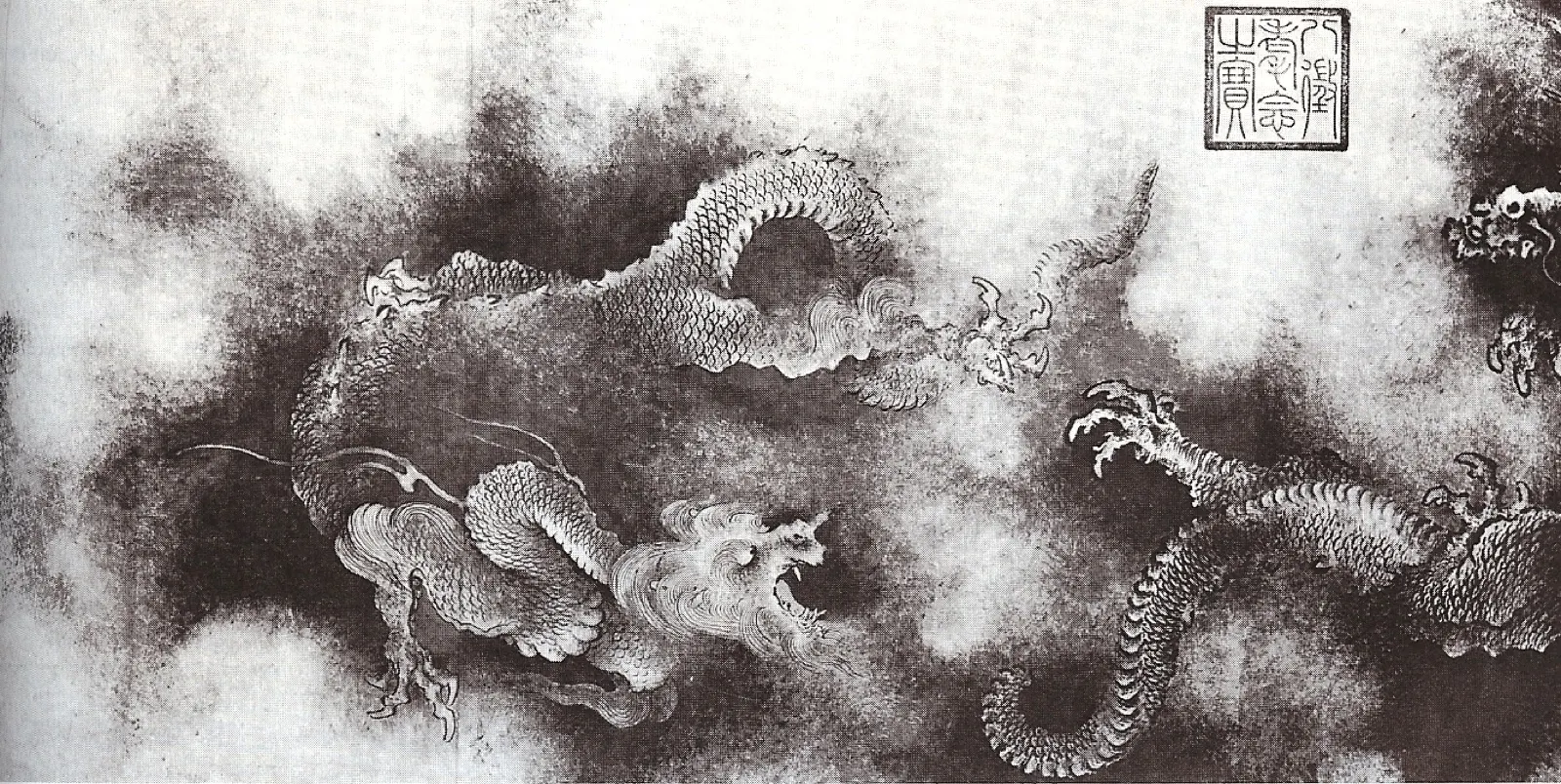

*Nine Dragons* (九龍圖卷) is a handscroll by Chen Rong (1200–1266), dated 1244. The ink and colour painting shows dragons among cloud, mist, whirlpools, rock and fire. It is in the Museum of Fine Arts, Boston (accession 17.1697), which bought it in 1917 from Yamanaka and Co. for $25,000. The scroll is almost 15 metres long (46.8 by 1496.5 cm).
The artist’s inscription describes dragons bringing rainfall, and the spattered ink is read as a rain-making gesture.
A nine-dragon wall is a screen wall with reliefs of nine different dragons. Three survive in China. In Beijing, the Nine-Dragon Wall in Beihai Park was built in 1756 and is about 25.5 metres long, inlaid with glazed bricks. The Forbidden City has a glazed screen in front of the Gate of Imperial Supremacy, built under the Qianlong emperor and about 30 metres long. In Datong, Shanxi, the oldest and largest survives from the Ming, when it stood before the mansion of the Ming prince Zhu Gui.
Nine is the number of heaven in Chinese thought, so the dragon is described by nine attributes and has 117 scales: 81 yang and 36 yin.[1][5][6][14][15][16]
Dragon dance, dragon boats and the New Year
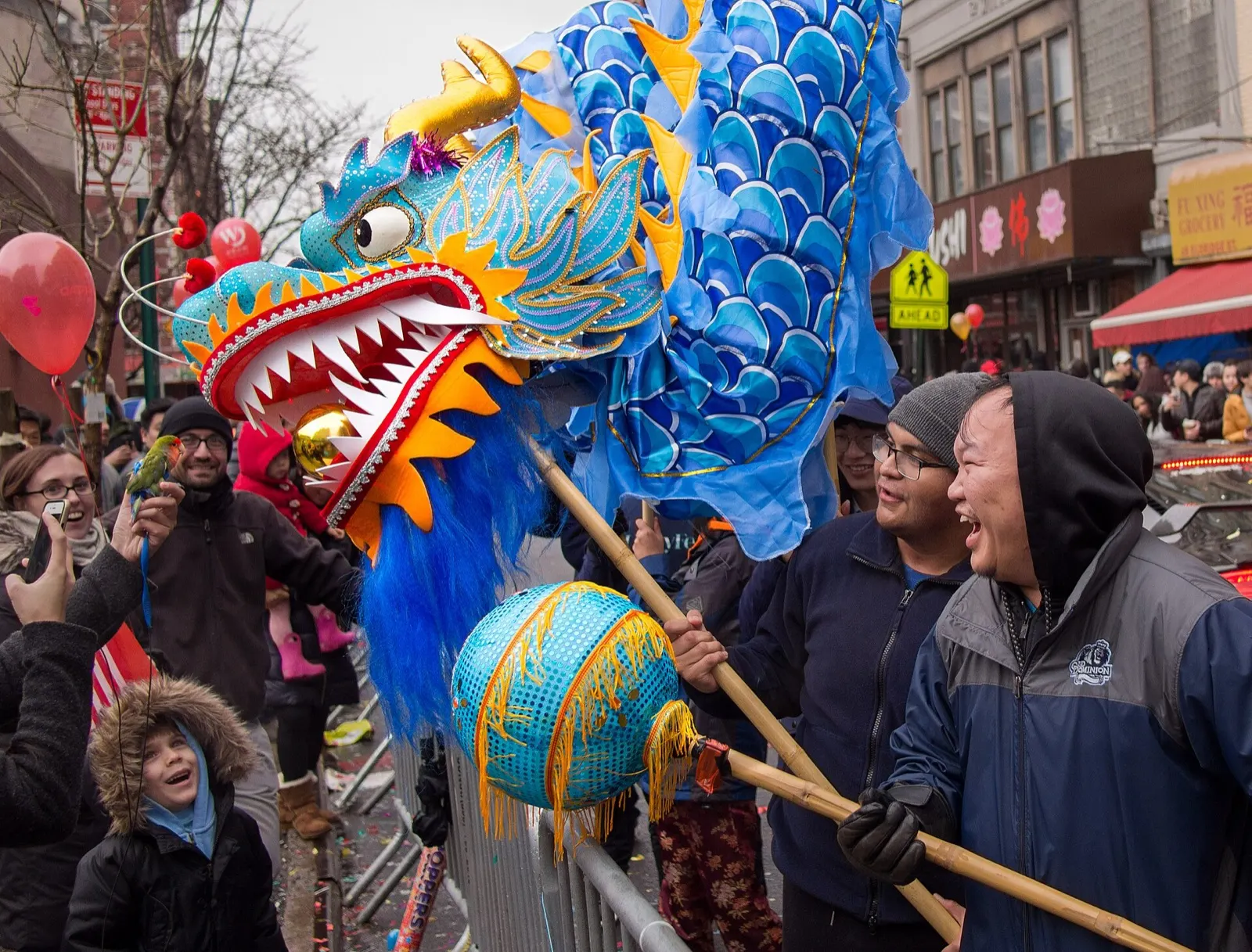

Dragon dance (舞龙, wǔ lóng) is performed by a team that carries a long puppet of cloth and wood on poles and moves it in wave-like patterns. It is most often seen at Chinese New Year and at the opening of shops and homes. The longer the dragon, the more luck it is believed to bring. A standard dragon is about 34 metres, in nine major sections with 81 rings.
Dragon boat racing is the other great dragon event. The boats have a carved dragon head and tail and are paddled by teams of up to 20, with a drummer and a steersman, at the Dragon Boat Festival.
Two dragon idioms are still in use. 望子成龙 (wàng zǐ chéng lóng) means “hoping one’s child will become a dragon”, and “dragon versus tiger” describes equal rivals.[1][9]
Dragon names on everyday things
The best-known tea with a dragon in its name is Longjing (龙井茶), “Dragon Well”. It is named after a well near Longjing village in Hangzhou. Its name is said to come from the way rainwater on the well’s surface twists like a dragon. See our Chinese green tea guide for the tea itself.[24]
Dragon-year babies, then and now
2024 was a Dragon year. China recorded 9.54 million newborns (954万), 520,000 more than in 2023, and a birth rate of 6.77 per 1,000. Births had fallen for seven consecutive years before this rise.
China Daily attributed the rise to a surge in marriage registrations after the pandemic, to the Year of the Dragon, which traditionally brings a baby boom, and to childbirth support policies. The dragon is seen as the most auspicious of the twelve zodiac animals. For the zodiac dragon and its year table, see the Dragon zodiac page.[20][21]
Chinese and Western dragons side by side
| Chinese dragon (lóng) | Western dragon | |
|---|---|---|
| Usual form | Snake-like with four legs; mostly wingless, with turtle and fish forms too | Breathes fire |
| Temperament | Benevolent at first; later Buddhist texts describe malevolent dragons who cause floods | Seen as aggressive |
| Main power | Rain, rivers, seas and weather | Fire |
Questions readers ask
What does the Chinese dragon symbolise?
Good luck, prosperity and control of water and rain. It was also tied to the emperor and imperial power for many dynasties, and it is a spiritual symbol rather than a monster.
What is the Chinese dragon called?
Lóng (龙). It is also spelled long or loong. Over 100 dragon names appear in classical Chinese texts, and not all of them use the word lóng.
How many claws does a Chinese dragon have?
Five claws marked the imperial family, according to the Met’s reading of its Qing robes. Dragons with fewer claws were used for lower ranks, but this page does not give a sourced count for each rank.
What is the difference between Chinese and Western dragons?
Chinese dragons are usually wingless, snake-like and benevolent, and they control water and rain. Western dragons are described as fire-breathing and seen as aggressive.
Who are the main Chinese gods?
The Jade Emperor heads the heavenly court in Taoism and folk religion, Caishen is the God of Wealth, Chang’e lives on the Moon, and the Dragon Kings rule the seas and rain. The table above lists them with when you meet them.
What is the Chinese phoenix?
Fenghuang (凤凰), a bird that reigns over all others. It is usually paired with the dragon as a symbol of a happy marriage and of yin and yang in balance.
What are the nine sons of the dragon?
Nine decorative creatures used on steles, roofs, bells, gates, incense burners and door knockers. The lists differ by source; the most widely found is Yang Shen’s, which gives Bixi, Chiwen, Pulao, Bi’an, Taotie, Qiuniu, Yazi, Suanni and Jiaotu.
What is a dragon dance?
A team carries a long puppet dragon on poles and moves it in wave-like patterns, usually at Chinese New Year or to open a shop. A standard dragon has nine major sections and 81 rings.
Sources
- Wikipedia, Chinese dragon · accessed 10 Nov 2026
- Wikipedia, Nine sons of the dragon · accessed 10 Nov 2026
- Wikipedia, Four Symbols · accessed 10 Nov 2026
- Wikipedia, Dragon King · accessed 10 Nov 2026
- Museum of Fine Arts, Boston, collection record, Nine dragons, Chen Rong, accession 17.1697 · accessed 10 Nov 2026
- Wikipedia, Nine Dragons (painting) · accessed 10 Nov 2026
- Wikipedia, Fenghuang · accessed 10 Nov 2026
- Wikipedia, Chinese mythology · accessed 10 Nov 2026
- Wikipedia, Dragon dance · accessed 10 Nov 2026
- Wikipedia, Jade Emperor · accessed 10 Nov 2026
- Wikipedia, Nüwa · accessed 10 Nov 2026
- Wikipedia, Chang’e · accessed 10 Nov 2026
- Wikipedia, Qilin · accessed 10 Nov 2026
- Beijing Municipal Government, Beihai Park, Nine-Dragon Wall (2023) · accessed 10 Nov 2026
- China Culture (chinaculture.org), Forbidden City · accessed 10 Nov 2026
- China Daily, The Nine Dragon Screen, Datong (28 August 2020) · accessed 10 Nov 2026
- Palace Museum Youth (Palace Museum, Beijing), The Misfortunate Dragon Throne · accessed 10 Nov 2026
- Metropolitan Museum of Art, Denise Patry Leidy, Peacocks and Dragons, Oh My! (3 January 2014) · accessed 10 Nov 2026
- Metropolitan Museum of Art, Five-Clawed Dragon Robe, Qing dynasty, object 1973.95 · accessed 10 Nov 2026
- National Bureau of Statistics of China, Statistical Communiqué on the 2024 National Economic and Social Development (28 February 2025) · accessed 10 Nov 2026
- China Daily, China’s newborns rise in 2024, first time in years (17 January 2025) · accessed 10 Nov 2026
- Visit Beijing (Beijing Municipal Bureau of Culture and Tourism), Spring Festival: custom guide of the first lunar month · accessed 10 Nov 2026
- Wikipedia, Caishen · accessed 10 Nov 2026
- Wikipedia, Longjing tea · accessed 10 Nov 2026
- Wikipedia, Kitchen God (Zao Jun, the Stove God) · accessed 10 Nov 2026
- Wikipedia, Guanyin · accessed 10 Nov 2026
Update log. 10 November 2026 — reviewed. Next review due 8 February 2027. Suggest a correction